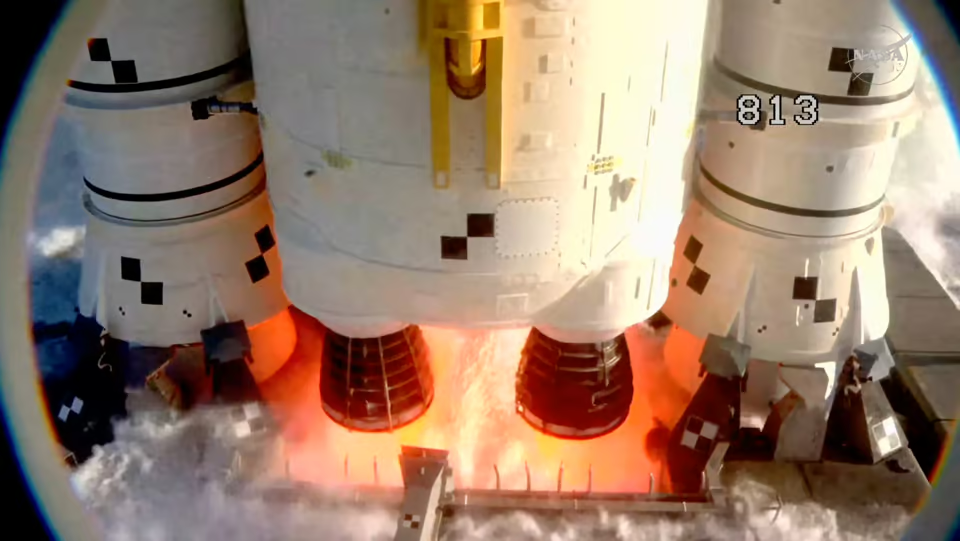
It happened. On April 1, 2026, at exactly 6:35 p.m. EDT, the ground beneath the Kennedy Space Center shook, the sky ignited, and humanity took its first deliberate step back toward the Moon in over half a century. Watching the Space Launch System (SLS) rocket roar through the atmosphere with the Orion spacecraft perched on top, I felt a familiar, overwhelming sense of awe.
Right now, as I sit at my desk typing this, four human beings—Commander Reid Wiseman, Pilot Victor Glover, and Mission Specialists Christina Koch and Jeremy Hansen—are currently hurtling through the vacuum of space on a 10-day mission around our closest celestial neighbor.
Here at Cosmic Websites, we don’t just use space as a clever branding gimmick. The cosmos is woven into our DNA. As a web designer and digital marketer, I have always looked to the night sky for inspiration. The sheer vastness of space—the infinite darkness punctuated by brilliant, burning stars—reminds me of the digital landscape. It is boundless, entirely full of possibilities, and waiting to be explored.
Today, I want to talk about the Artemis II mission, why it is so deeply motivating to me personally, and how the relentless pursuit of the stars mirrors the journey of building an unforgettable brand online.
The Artemis II Mission: A Masterclass in Human Ingenuity
If you haven’t been tracking the mission via NASA’s Artemis Real-time Orbit Website (AROW), let me catch you up on the monumental SEO-worthy tech and human ambition currently orbiting above us. Artemis II is not just a sequel to the Apollo missions; it is an entirely new chapter in deep space exploration.
This 10-day flight is the first crewed lunar mission since Apollo 17 in 1972. But unlike the missions of the past, Artemis II is testing the viability of deep space systems designed to establish a permanent human presence on the Moon, and eventually, Mars. The Orion spacecraft is pushing the absolute limits of human engineering, currently navigating a free-return trajectory that will take it over 248,000 miles from Earth, swinging around the far side of the Moon before setting a course for a high-velocity Pacific Ocean splashdown on April 10.
But what truly makes Artemis II historic is the crew. This mission represents the best of humanity’s diverse future. Victor Glover is the first person of color to fly to the Moon. Christina Koch is the first woman to make the lunar journey. Jeremy Hansen is the first Canadian (and non-American) to leave low-Earth orbit.
Watching this diverse, brilliant team break barriers is profoundly moving. It reminds us that when we combine different perspectives, backgrounds, and talents, we can achieve the extraordinary. In the world of web design and digital marketing, this same philosophy holds true. The best digital experiences are built when diverse ideas collide, creating websites that are inclusive, accessible, and universally impactful.
Why the Vastness of Space Inspires My Digital Canvas
People often ask me, “Maddy, why the intergalactic theme for a web design agency?” The answer is simple: Perspective.
When I look up at the stars, I don’t just see balls of burning gas; I see the ultimate blank canvas. Space is the definition of limitless potential. As a designer, that is exactly how I view a blank web page. The internet is our modern-day galaxy—a vast, ever-expanding universe of data, ideas, and brands fighting to be seen.
When a client comes to Cosmic Websites, they are usually lost in the digital void. They have a brilliant business, but their online presence is just floating aimlessly, devoid of gravity. My job as the Owner and Lead Designer is to be their Mission Control. I look at the endless possibilities of code—the HTML, the CSS, the JavaScript—and I see the building blocks of a new solar system.
The vastness of space teaches us that there is always room to grow, always a new frontier to discover. Whether it’s implementing the latest advancements in artificial intelligence, mastering the ever-changing algorithms of SEO, or creating a fluid, responsive user interface that feels like magic, the digital world requires the same forward-thinking momentum as space exploration. If you aren’t moving forward, you’re drifting.

Launching a Website is Like Launching a Rocket
The parallels between a NASA space mission and a successful website launch are striking. Both require meticulous planning, rigorous testing, and a flawless execution strategy. Here is how we translate the mechanics of a moonshot into our web design process at Cosmic Websites:
1. The Blueprint (Mission Planning)
NASA didn’t just build a rocket and light the fuse. Decades of mathematics, engineering, and architectural planning went into the SLS. Similarly, a high-converting website begins long before the first line of code is written. We start with wireframing, user experience (UX) mapping, and defining your brand’s core mission. We figure out exactly who your target audience is (your destination) and map the most efficient trajectory to get them there.
2. The Build (Assembly in the VAB)
The Vehicle Assembly Building is where the rocket comes together. In our digital agency, this is the development phase. We use the most robust, modern frameworks to build a website that is structurally sound. Just as the Orion capsule needs life support systems, your website needs seamless integrations—e-commerce gateways, CRM connections, and lightning-fast loading speeds to ensure the user survives and thrives in your digital environment.
3. The Thrusters (SEO and Digital Marketing)
A rocket without thrusters is just an expensive tower. A beautiful website without Search Engine Optimization (SEO) and digital marketing is a billboard in the desert. We engineer our websites with brilliant, technical SEO baked into the code. We target high-value keywords, optimize meta descriptions, and build content strategies that act as the solid rocket boosters, propelling your website to the top of Google’s search rankings.
4. Splashdown and Orbit (Launch and Maintenance)
When Artemis II splashes down on April 10, the mission isn’t over; the data analysis begins. When we push your website live, our job transitions into orbit. We monitor analytics, track user behavior, run A/B tests, and make course corrections to ensure your digital presence remains dominant. The internet, much like space, is hostile and ever-changing. You need a dedicated Mission Control to keep you secure and operational.
The Courage to Explore the Unknown
There is a specific kind of courage required to strap yourself to millions of pounds of explosive rocket fuel and launch into the black void of space. While launching a new business or rebranding your company online doesn’t carry the same physical risks, it requires a similar emotional bravery. It is scary to put your brand out there. It is intimidating to navigate the complex algorithms, the competitors, and the rapid pace of digital evolution.
But that is why Artemis II is so motivating. It proves that with the right team, the right technology, and a refusal to accept the boundaries of the past, you can reach destinations that once felt impossible.
As I watch the live telemetry of the Orion spacecraft beaming back to Earth, I am reminded of why I started Cosmic Websites. I wanted to build an agency that doesn’t just build “pages” on the internet, but creates digital experiences that command attention across the galaxy. I wanted to help passionate business owners launch their brands into orbit.
The Artemis II crew is currently writing history among the stars. It’s time for us to write yours on the web.
Are you ready to break the atmosphere? If you are looking for a web design and marketing agency that approaches your brand with the precision of a space agency and the creativity of the cosmos, Mission Control is waiting for your signal. Let’s build something stellar together.