By Maddy | Lead Designer & Founder, Cosmic Websites
I’ve always been a bit of a stargazer. There is something wildly humbling about standing in your backyard on a crisp, clear night, looking up at the inky expanse of the cosmos, and realising just how vast the universe truly is. The possibilities up there are endless. It’s that exact feeling—that boundless, untamed potential—that inspired me to found Cosmic Websites. To me, launching a new brand into the digital universe isn’t just a job; it’s an expedition.
And right now, humanity is on the brink of one of the greatest expeditions of our lifetime.
As the Artemis II mission makes its historic flight, carrying four astronauts farther into space than any human has traveled in over fifty years, the world is watching. But the most crucial part of their journey? It happens completely out of sight.
When the Orion spacecraft swings around the far side—the “dark side”—of the moon, it will lose all radio contact with Earth. For a tense, breathtaking window of time, those astronauts will be completely in the dark, relying entirely on the invisible, complex infrastructure built into their ship to keep them alive and on course.
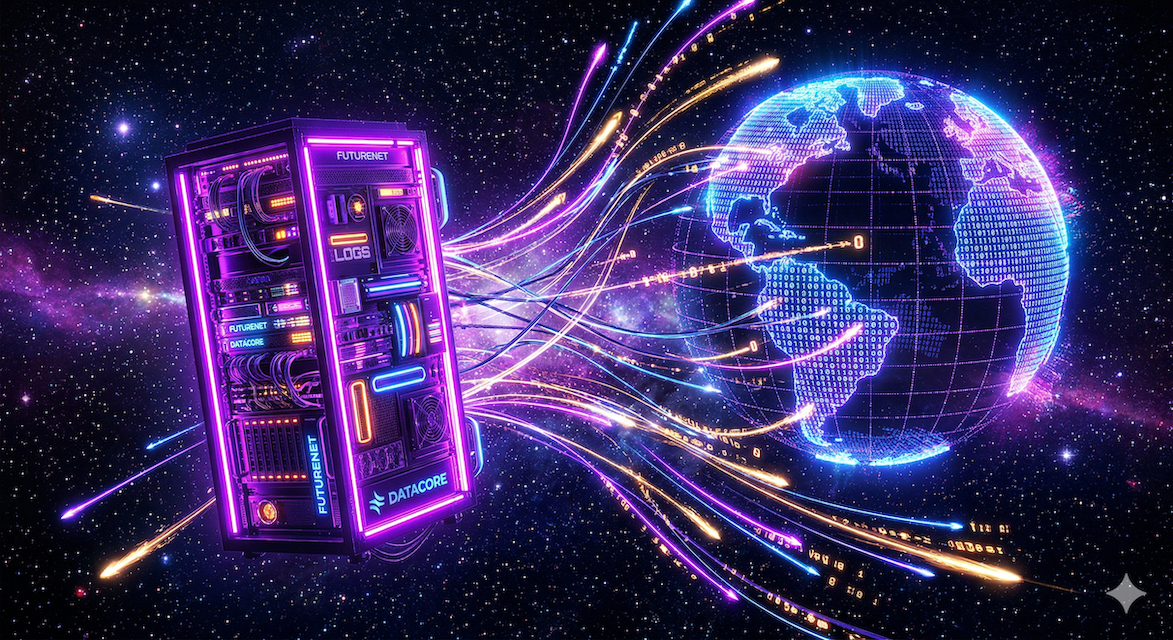
It got me thinking about the digital spacecraft we build every day at Cosmic Websites. Everyone loves a beautiful, glowing frontend. But the most vital part of your website? It’s the infrastructure operating in the dark.

The Historical Gravity of Artemis II
To understand the weight of this analogy, we have to talk about what Artemis II is actually doing. This isn’t just a repeat of Apollo. NASA’s Artemis program is rewriting the rulebook on deep-space exploration.
The Artemis II crew isn’t just flying to the moon; they are flying beyond it. They are charting a free-return trajectory that will take them roughly 4,600 miles past the lunar far side. When they enter that shadow, the moon itself will block all communications with Mission Control in Houston. No telemetry. No voice comms. No quick Google searches to troubleshoot a problem.
For those hours, the crew’s survival depends entirely on systems designed, tested, and buried deep within the hull of the spacecraft. The life support systems regulating oxygen and temperature, the propulsion codes, the radiation shielding—none of these things are “pretty.” You won’t find them on a NASA marketing poster showcasing the sleek exterior of the rocket. But without them, the mission fails before it even begins.
The historical value of this moment cannot be overstated. By successfully navigating the dark side of the moon’s orbit, Artemis II proves that our underlying technology is robust enough to eventually take us to Mars. It proves that what happens in the dark is just as critical as the fiery, highly televised launch.

The Cosmic Connection: Your Website’s “Dark Side”
At Cosmic Websites, I spend a lot of time talking to clients about aesthetics. We talk about typography that floats seamlessly across the screen, color palettes that evoke emotion, and user interfaces that feel as intuitive as gravity. That’s the frontend of your website. It’s the shiny hull of the rocket. It’s what the press and the public see.
But then, I bring up the backend. I talk about server response times, database architecture, SSL certificates, API integrations, and code minification.
Usually, that’s when eyes glaze over.
I get it! Infrastructure isn’t sexy. It operates entirely in the dark, well out of sight of your website visitors. But just like the vital systems on the Artemis II spacecraft, your backend web infrastructure is the invisible force keeping your digital mission alive. If your backend is built on messy code, fragile databases, or cheap, unreliable hosting, your beautiful frontend won’t save you when traffic surges or a security threat hits.
Let’s break down exactly how your website’s hidden infrastructure mirrors the deep-space systems of a lunar mission.
1. Mission Control & Server Architecture
When you type a URL into your browser, you are sending a signal out into the digital void. Your server is Mission Control. It receives that signal, processes the request, and beams the website back down to the user’s screen. If your server architecture is weak, that transmission takes too long. In space, a delayed transmission is a crisis; on the web, a delayed load time means an abandoned shopping cart and a lost customer. A robust backend ensures your server responds at lightspeed.
2. The Data Core: Your Database
Imagine the Artemis II crew trying to navigate without their flight logs, star charts, or system data. They’d be flying blind. Your website’s database is its central computer. It stores every user profile, every blog post, every product inventory number, and every password. Structuring this data efficiently in the “dark” means that when a user searches for a product on your site, the database retrieves it instantly, without crashing the ship.
3. The Heat Shield: Cybersecurity
Space is hostile. There is radiation, micro-meteoroids, and extreme temperature fluctuations. The internet is equally hostile, swarming with bots, malware, and bad actors probing for vulnerabilities. You can’t see the firewall, the encryption protocols, or the secure payment gateways, but they act as your digital heat shield. They protect your users’ sensitive data from the friction and fire of the open web.

Why We Must Build for the Dark
There is a dangerous trend in modern web design: relying entirely on heavy, drag-and-drop page builders that prioritize visual speed over structural integrity. It’s the equivalent of building a spaceship out of cardboard and painting it silver. Sure, it looks great on the launchpad, but the second it hits the vacuum of space, it falls apart.
When infrastructure is ignored because it “lives in the dark,” the consequences are severe:
- Plummeting SEO: Search engines like Google are the ultimate flight inspectors. They look under the hood. If your backend is bloated with messy code, Google will ground your site, dropping you down the search rankings.
- Poor User Experience (UX): A button might look beautiful, but if the backend script routing that button’s function is broken, the user is left stranded.
- Scalability Issues: If your business goes viral and your traffic skyrockets by 1,000%, a fragile backend will crash. You want your website to reach the stars, but your infrastructure needs to be able to handle the G-force of that growth.
As a designer, it took me a while to fall in love with the dark side of web development. I am a visual person; I thrive on the artistic possibilities of a blank digital canvas. But as I watched Cosmic Websites grow, and as I took on larger, more complex projects, I realized that true digital artistry requires a mastery of the unseen.
The vastness of space teaches us that to explore the unknown safely, you have to over-engineer your foundation. You have to anticipate the void.
Preparing for Your Own Launch
The Artemis II crew knows that when they slip behind the moon and the radio static gives way to total silence, they will be safe. They have absolute faith in the engineers, coders, and scientists who built the unseen infrastructure around them.
That is the exact feeling of security I want every single client at Cosmic Websites to experience.
When you launch a business, an e-commerce platform, or a digital portfolio, you shouldn’t have to lie awake at night wondering if your server will crash, if your site will be hacked, or if your pages are loading fast enough for mobile users. You should be focused on the stars—on the growth, the sales, and the connections you are making.
We build websites from the ground up, honoring the aesthetics of the frontend while fiercely protecting the integrity of the backend. We code in the dark so you can shine in the light.
Space exploration and web design aren’t so different when you zoom out far enough. Both require a dream big enough to leave the ground, and a system strong enough to survive the journey. The Artemis II mission is about to make history by trusting the unseen. Isn’t it time your brand did the same?
Ready to start your countdown? The digital universe is vast, but you don’t have to navigate it alone. Let’s build something cosmic together. Reach out to the team at Cosmic Websites today, and let’s engineer alaunch that goes the distance.